
Classic Canasta
Play Classic Canasta online free or offline vs smart AI — two or four players, partnership play, Quick Games and full matches.
- Free • No Sign-Up
- 2 or 4 Players
- Smart AI Partner
- Easy • Medium • Hard
Classic Canasta
Play Classic Canasta online free or offline vs smart AI — two or four players, partnership play, Quick Games and full matches.
- Free • No Sign-Up
- 2 or 4 Players
- Smart AI Partner
- Easy • Medium • Hard
Help shape Classic Canasta
Help Us Make Canasta Even Better
Classic Canasta is ready to play, and we’re still actively refining the AI and features. If you spot a bug or have thoughts about the gameplay, rules or experience, we’d love to hear from you.
Send FeedbackAbout Classic Canasta
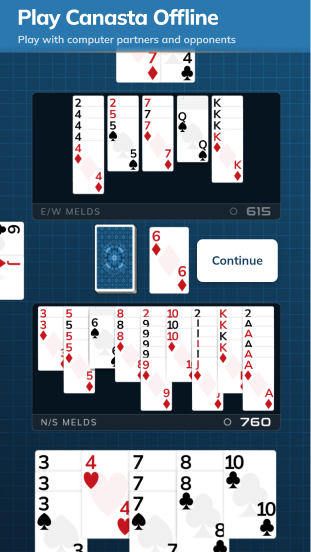
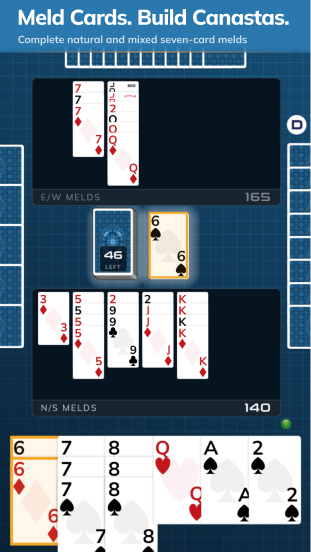
Classic Canasta is the celebrated melding game played with two standard decks and four jokers. Build melds of matching ranks, turn seven-card melds into canastas, and combine card values with canasta, red-three and going-out bonuses as you race to the winning score.
Every turn asks you to choose between drawing from the stock and taking the whole discard pile. Natural and mixed canastas, wild cards, opening meld requirements, red and black threes, and frozen-pile rules give each hand its distinctive tactical shape.
Play head to head with two players or team up with a smart AI partner in the classic four-player partnership game. Choose Easy, Medium or Hard opponents, play a full match to 5,000 points or a single-hand Quick Game, and customise the rules and presentation to suit you. Play free in your browser now, with the iPhone, iPad and Android apps coming soon.
Quickfire Rules
See it in action
Coming soon
Coming soon to App & Play Stores


Classic Canasta Terms
Meld — Three or more cards of the same rank, face up on the table. Wild cards may fill in for missing cards.
Canasta — A meld of seven or more cards. A natural canasta contains no wild cards; a mixed canasta contains one to three.
Wild cards — The 2s and the jokers. A wild card can stand in for any rank in a meld.
Natural cards — Any card that is not wild and not a three – the 4s up to the aces.
Red threes (3♥ 3♦) — Bonus cards. They are never held or melded – they are laid out beside your melds automatically and replaced with a fresh card.
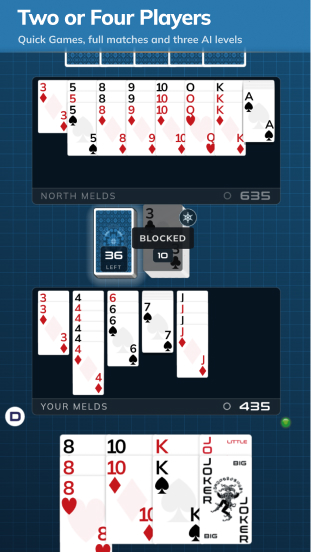
Black threes (3♠ 3♣) — Stop cards. A black three on top of the discard pile blocks the pile until it is covered, and black threes may only be melded on the turn you go out.
Stock — The face-down pile players draw from.
Discard pile — The face-up pile players discard to. It is always taken as a whole, never one card at a time.
Frozen pile — A discard pile that can only be taken with a natural pair from your hand matching its top card.
Opening meld — Your side's first meld or melds of the hand, which must add up to a minimum number of card points (see Scoring below).
Laying off — Adding cards to a meld your side already has on the table.
Going out — Getting rid of every card in your hand, which ends the hand and earns a bonus.
Going out concealed — Going out in a single turn without having melded earlier in the hand, laying down your whole hand at once including a canasta. It earns a bigger bonus.
How Your Partner Plays
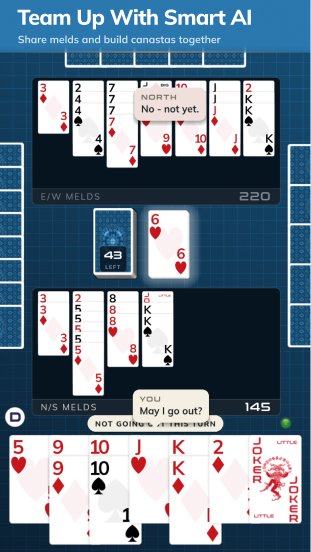
In a four-player game you and the AI opposite you play as one side. You share melds, canastas and a score, and either partner may add cards to any meld belonging to the partnership.
Your partner always plays at full strength, whatever difficulty you choose for the opponents. It works towards the canastas your side still needs, protects useful cards, avoids feeding the opponents, and treats your shared position rather than its own hand as the goal.
With Ask Permission enabled, either partner may ask “May I go out?” before committing cards. The answer is binding for that turn. A “no” means the partner has one worthwhile turn to complete a canasta or place costly cards before the side closes.
Strategy Tips
- Build towards a canasta, not just a collection of small melds: your side cannot go out until it has completed the required number.
- Treat wild cards as scarce. They rescue awkward melds, but too many wilds make a meld illegal and prevent it becoming a natural canasta.
- Taking the discard pile can transform a hand, but it also commits you to using the top card and may leave you holding a large number of points.
- Watch whether the pile is frozen or merely blocked. A frozen pile needs a natural pair from your hand; a black three blocks it only until another card covers it.
- Plan the opening meld around your side's live minimum. The target rises as your match score rises.
- In partnership play, value the cards and canastas your side can complete, not only the melds you personally started.
- Ask to go out before laying cards down when the option is enabled, and say no to your partner only when your next turn can materially improve the partnership's score.
Classic Canasta FAQs
Can I play Classic Canasta online free here?
Yes. Play free in your browser against computer players with no account or sign-up. Offline iPhone, iPad and Android apps are coming soon.
Can I play with two players or four players?
Yes. Two-player Canasta is head to head. Four-player Canasta is played by two partnerships, with you and an AI partner sharing melds and a score.
What is a canasta?
A canasta is a meld of at least seven cards of the same rank. A natural canasta has no wild cards; a mixed canasta contains one to three wild cards.
How do I take the discard pile?
You must take the whole pile and immediately use its top card in a legal meld or layoff. If the pile is frozen, you need a natural pair of the same rank in your hand.
What do red and black threes do?
Red threes are bonus cards that are laid down and replaced automatically. A black three on top of the discard pile blocks the next player from taking it.
How long is a game?
A full match continues until a side reaches 5,000 points. A Quick Game is one hand, with the highest-scoring side winning.
Are there different AI levels?
Yes. Choose Easy, Medium or Hard opponents. Difficulty changes decision quality and memory, not the deal; cards are never manipulated to make a level easier or harder.
How does the AI partner play?
Your partner always plays at full strength. It shares the partnership's melds and goals, helps complete canastas, avoids dangerous discards and makes strategic going-out decisions.
Which optional rules are included?
Options include two-canastas-to-go-out and draw-two for two-player games, Ask Permission for partnership games, an always-frozen discard pile, and full or Quick Games.
How To Play
Quickfire Rules
How to Play
Deal
Play
Melding
Taking the Discard Pile
Red Threes
Going Out
Your Partner
Scoring
Settings
Interface
During a Game
Play other classic card games
Bridge , Bid Whist , Gin Rummy , Classic Whist or Euchre !